Engineering-based cost segregation studies — delivered online, usually the next business day.

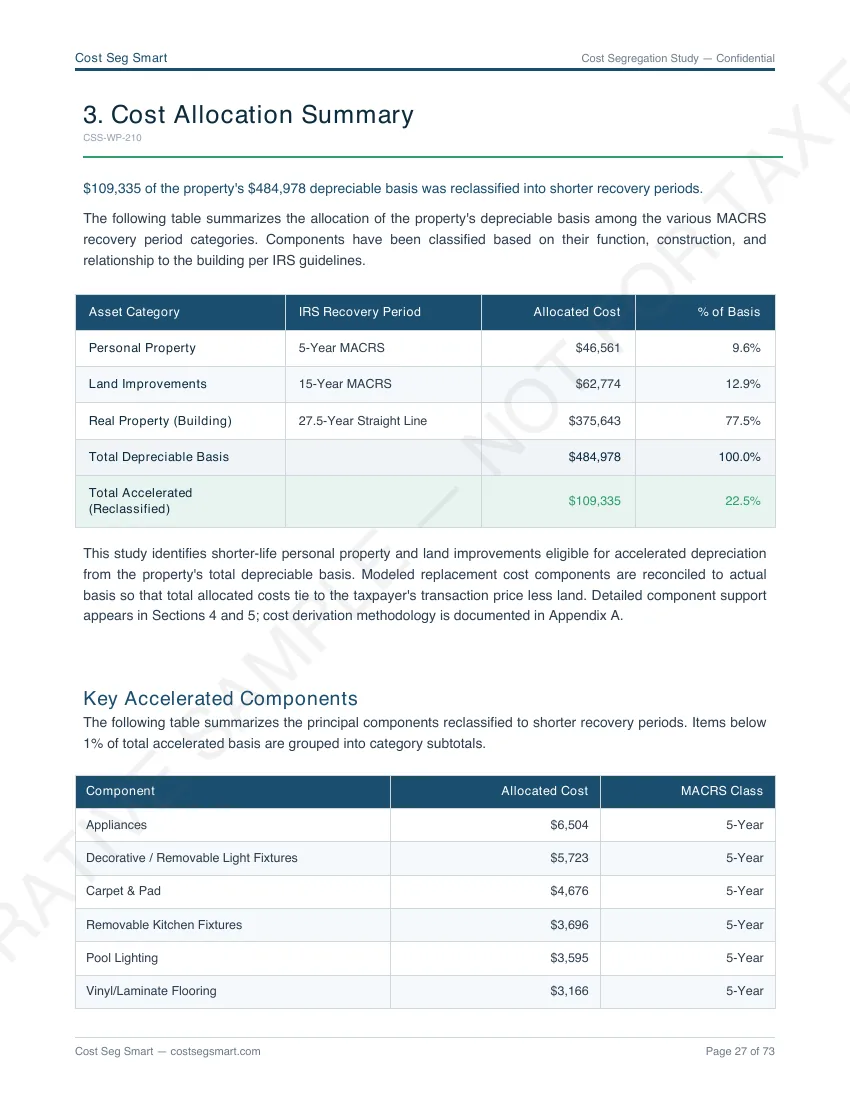
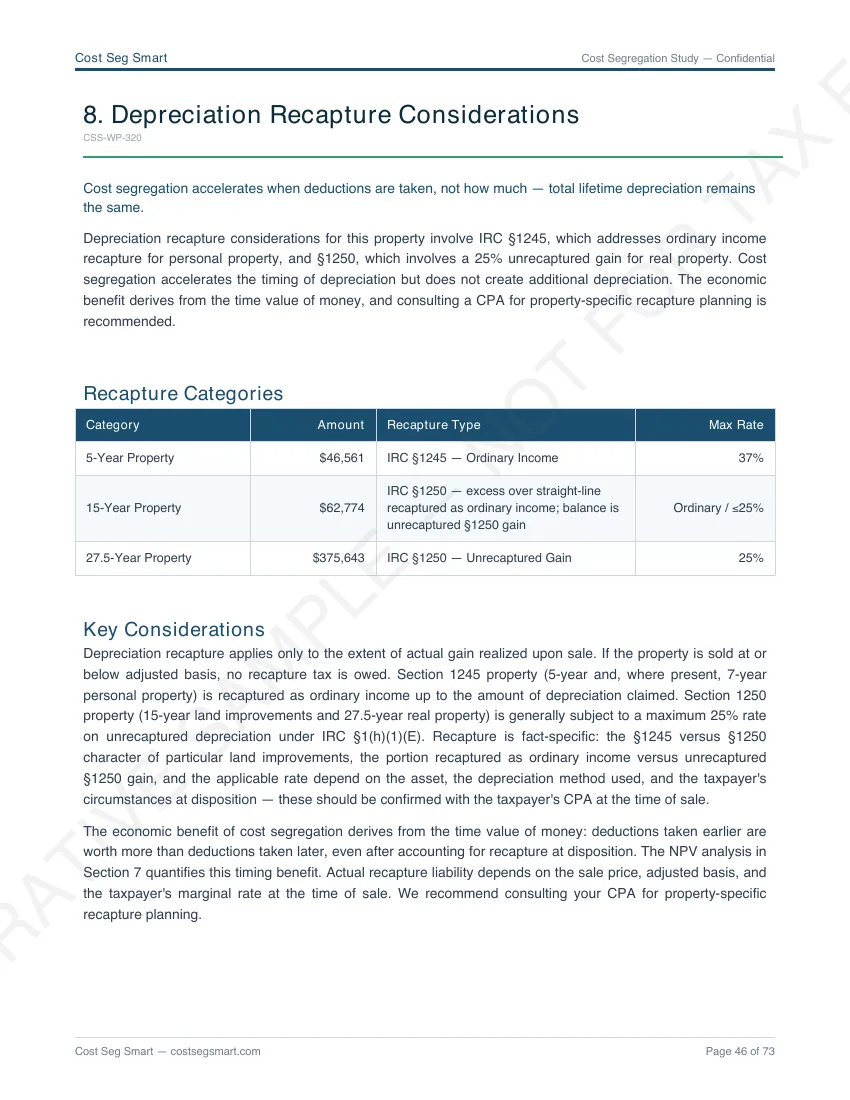
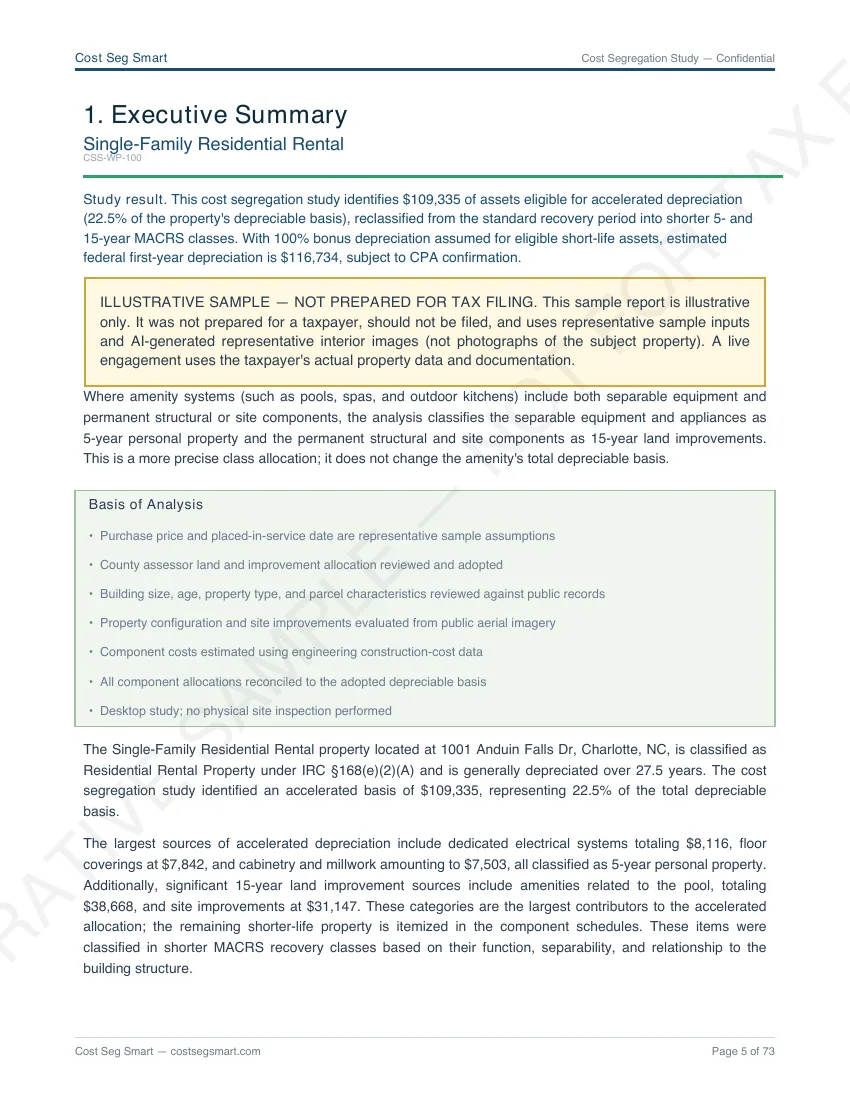
A cost segregation study is an engineering-based analysis that splits a building's cost into its components and assigns each one its IRS depreciation life, so parts like appliances, flooring and site work are written off over 5, 7 or 15 years instead of 27.5 or 39. We deliver it as a CPA-ready PDF report with the component schedule, depreciation tables and methodology, from $495. What a study is and how it works · sample report

Purchase price
$750,000
$200K$1M$5M+
Property type
 
Standard depreciation
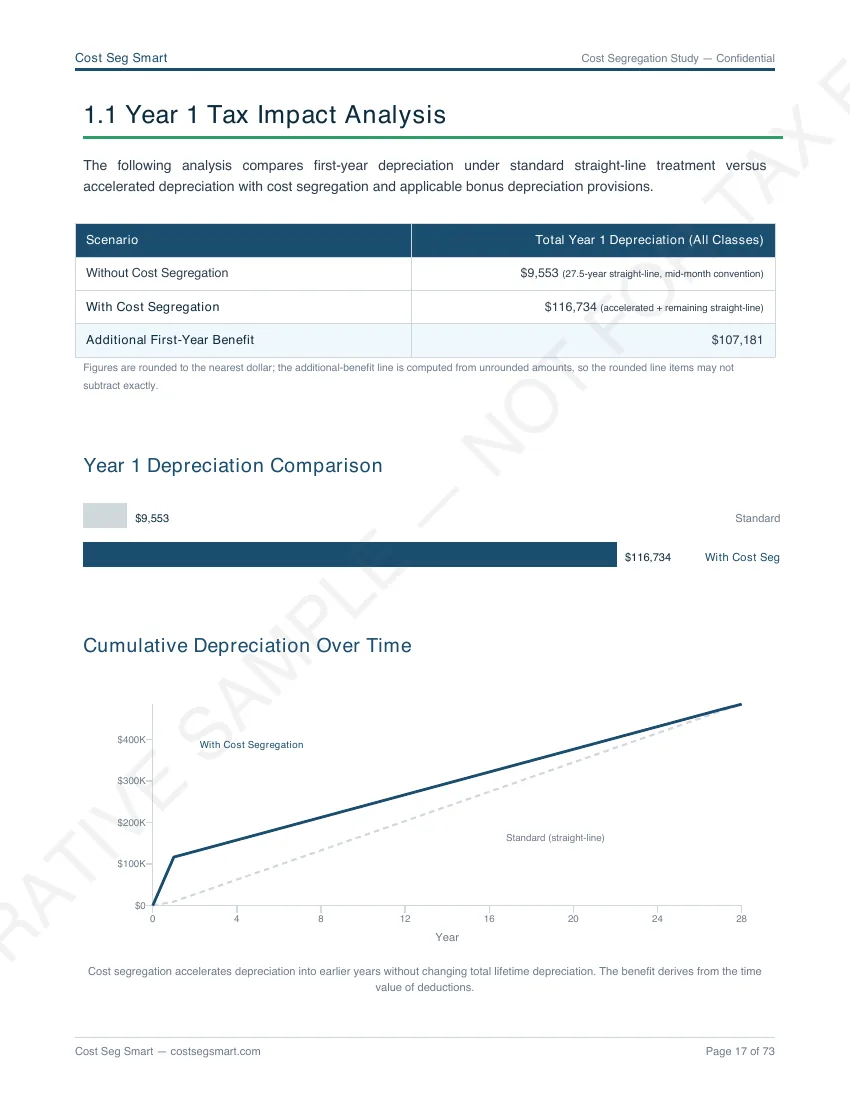
$3,491
Year 1 · 27.5-year straight-line
The default if you do nothing.
With cost segregation
$52,503
+$49,012 more·15.0× the deduction
Year-1 tax savings: typical $35,817–$73,519
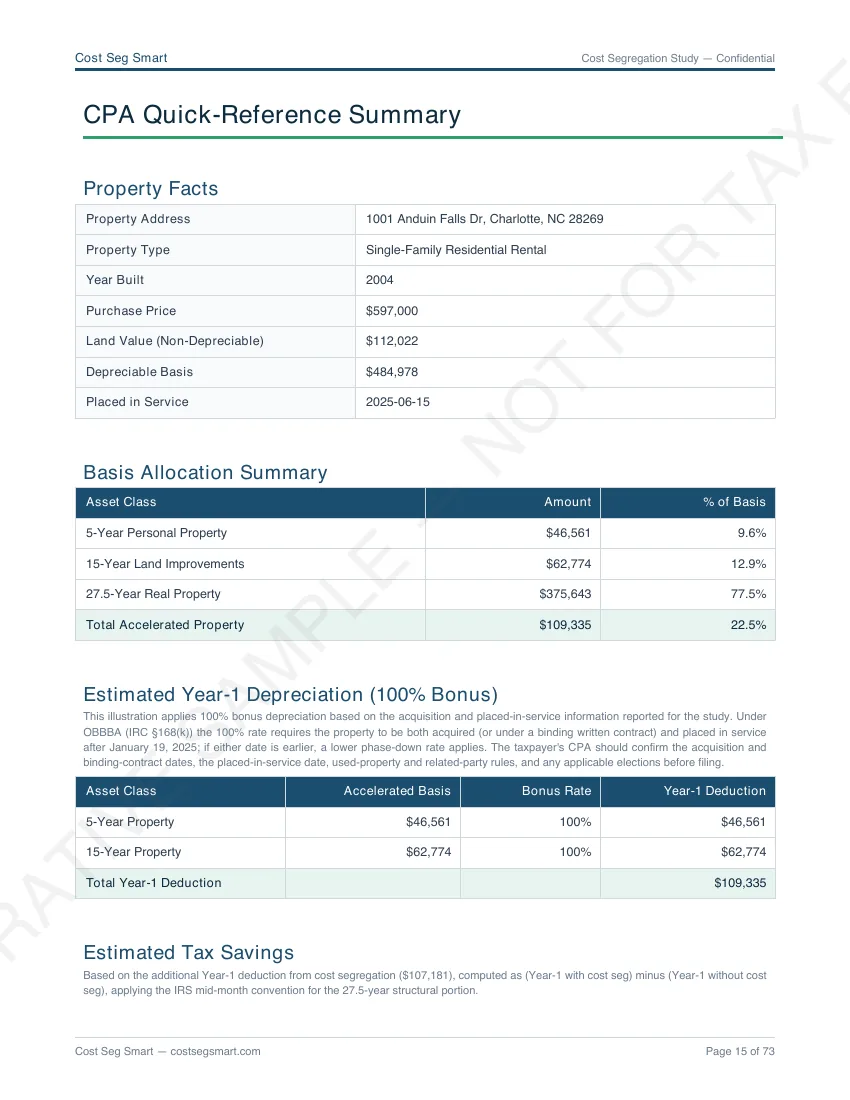
Reclassified to shorter lives — $156,000
Calibrated from 1,247 comparable short-term rentals
5-year property60% · $93,600
7-year furnishings20% · $31,200
15-year land improvements20% · $31,200
$995 unlocks $49,012 in Year-1 tax savings — 49× the study cost.
$995 is the flat price for this property — studies start at $495 and are priced by property type and basis. No add-ons.
Estimate from industry-standard construction cost data. The figure uses the typical share for this property type; your study can land above or below it.
Assumes a purchase this year. If you bought in an earlier year, less of it usually lands in year one — we ask for your purchase date when you order, and your study uses it.
IRS ATG-aligned
Audit Techniques Guide methodology
Usually the next business day
CPA-ready PDF delivered
CPA-ready guarantee
Free revision; refund if still unusable
Remote for most residential properties
Engineering-based, remote
The 30-second answer: Cost Seg Smart delivers engineering-based, fully documented cost segregation reports usually by the next business day starting at $495 — same engineering methodology and IRS Audit Techniques Guide framework as $5,000–$15,000 traditional firms. How much reclassifies depends heavily on property type: furnished short-term rentals typically 19–39% of depreciable basis, single-family rentals 5–32%, condos 10–17%, and commercial 18–34%. Individual results run wider in both directions — luxury finishes and unusual amenities push high, sparse unfurnished properties low. These are the measured ranges across our own delivered studies; see the bands we publish for every property type.
How it works

Three steps.
One hour.

We don't visit your property because the IRS doesn't require it. Big-4 firms charge $5,000–$15,000 for the same MACRS classification framework. We deliver it as a fixed-price product.

01

Tell us about your property

Address, purchase price, sqft, year built, acquisition date. Two minutes at checkout.

02

Our engineering model runs

industry-standard construction cost data, 200+ component models calibrated to region, MACRS classification per Rev. Proc. 87-56.

03

CPA-ready PDF in your inbox

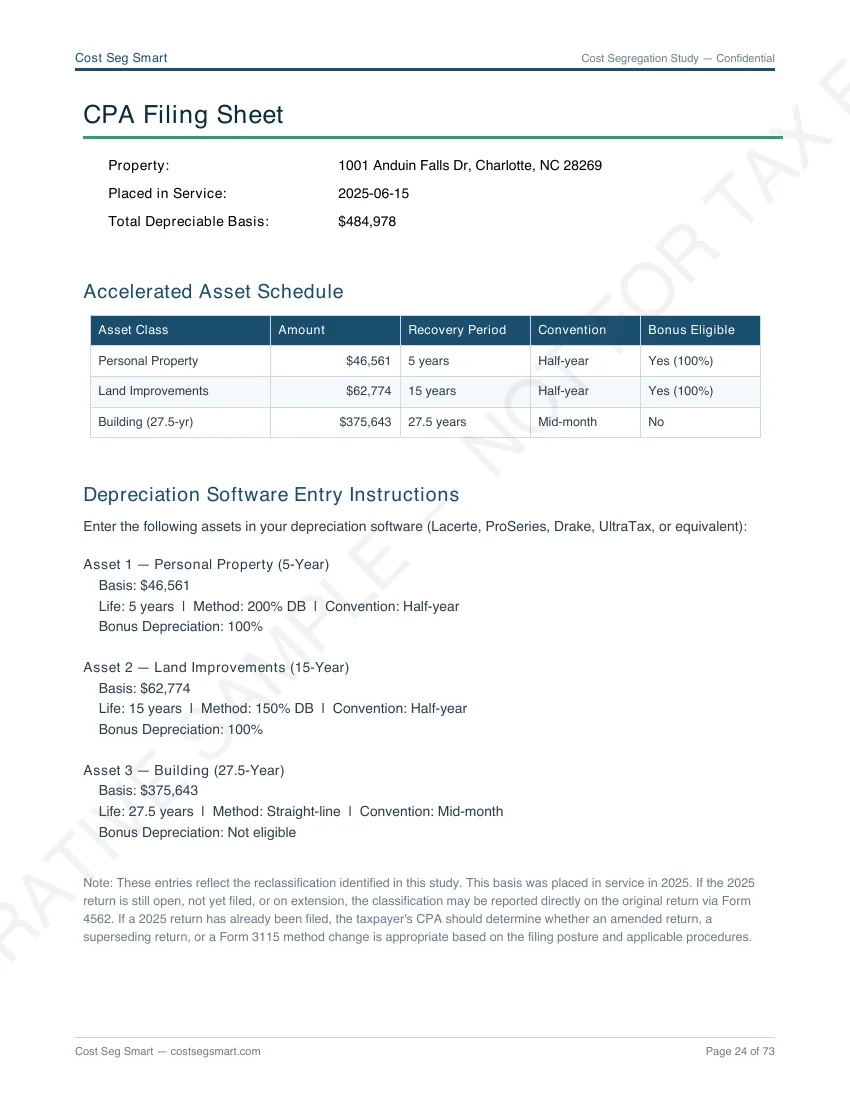
Component schedules, audit documentation, and a Form 3115 §481(a) schedule when a lookback applies. Ready for Form 4562.

Three ways to do this

Same IRS methodology.
Modern delivery.

Fraction of the cost. None of the consulting overhead.

This is us
Cost Seg Smart
$495 starting · one-time
Turnaround Usually the next business day
Site visit Not required
Methodology Engineering-based
CPA guarantee Free revision, then refund
Form 3115 §481(a) workpapers included
Audit support Life of the study
DIY software
$499 /yr subscription
Turnaround Hours of your time
Site visit You enter everything
Methodology Rule-based
CPA guarantee None
Form 3115 Not included
Audit support Varies
Traditional firm
$5K to $15K · one-time
Turnaround 4–8 weeks
Site visit Required
Methodology Engineering-based
CPA guarantee No
Form 3115 Add-on
Audit support Varies
The deliverable

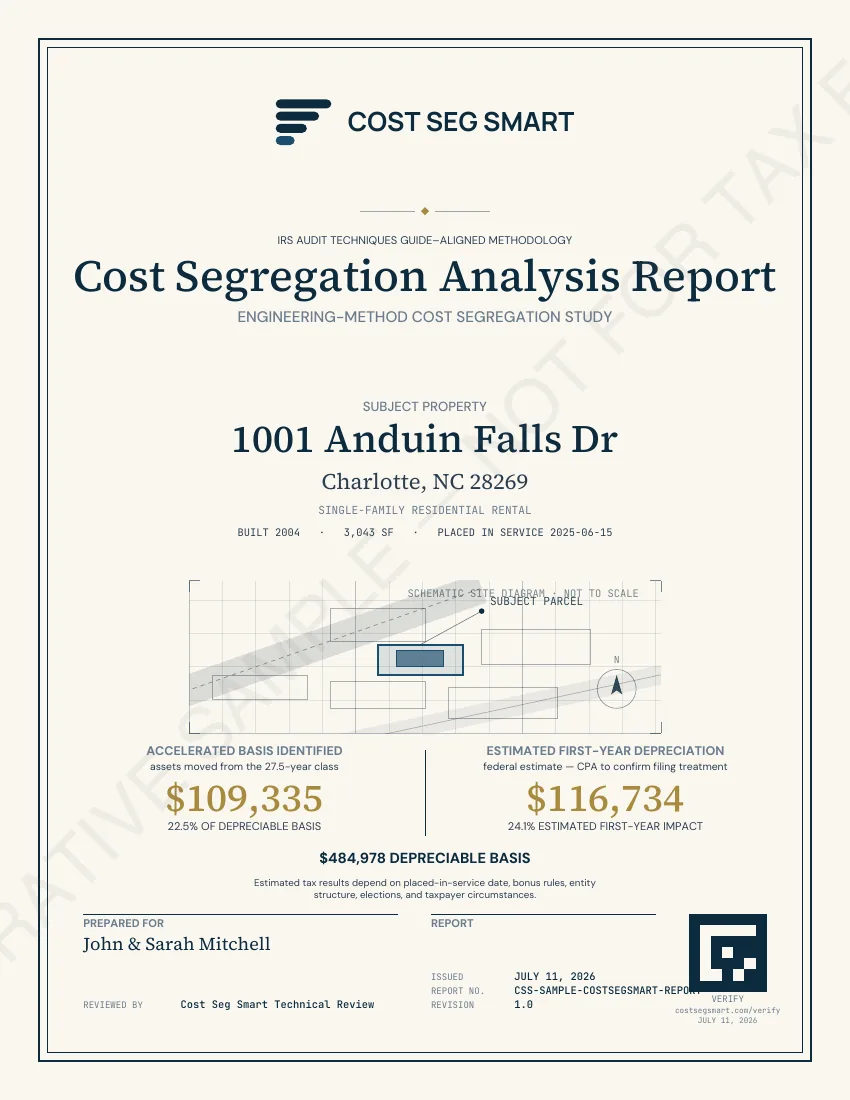
40+ pages your CPA can file from immediately.

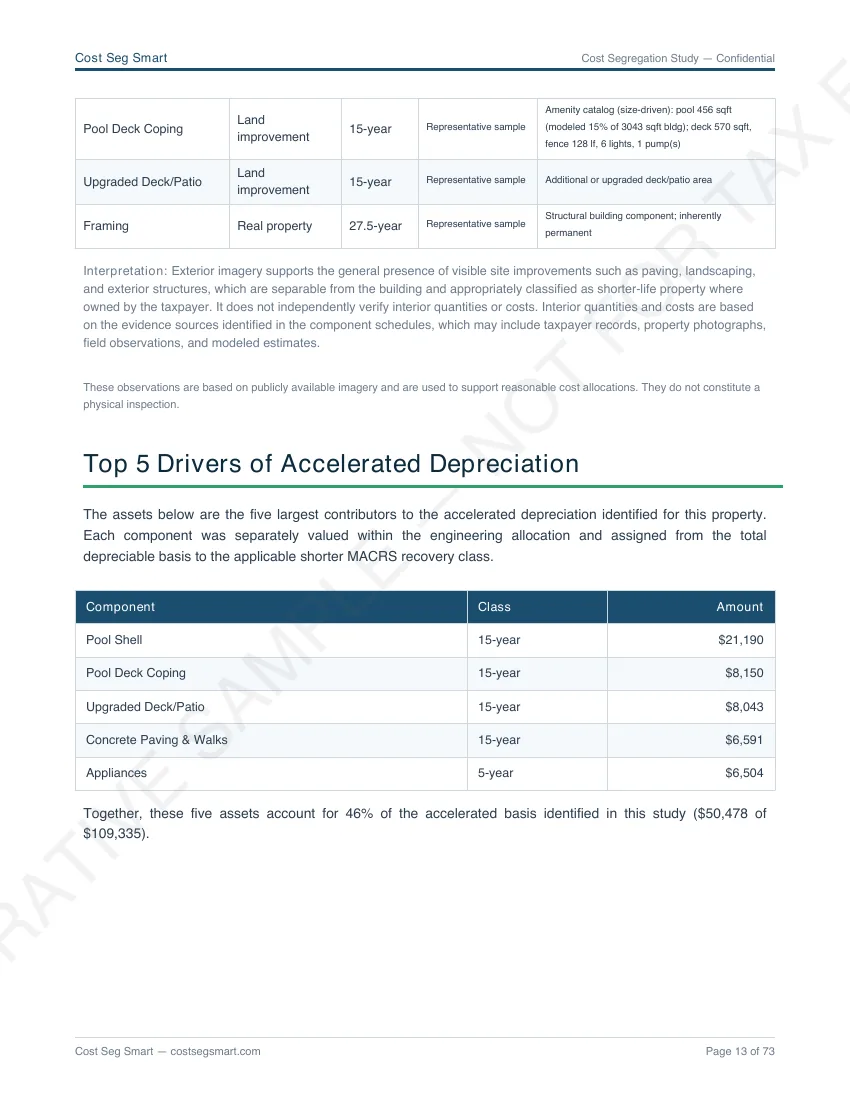
Component-level depreciation schedules. MACRS classification. Audit documentation aligned to the IRS Cost Segregation Audit Techniques Guide. A Form 3115 §481(a) schedule when a lookback applies.
Real customers · real reports

See an STR owner and a CPA walk through a real report.

Two unscripted reviews — the first by an Airbnb investor who ordered a study, the second by a CPA reviewing the methodology page-by-page.

STR investor review
An Airbnb owner walks through their study and Year-1 deduction.
CPA review
A CPA reviews the methodology and what they look for in a defensible study.
Verified reviews
What customers say on Trustpilot.
Pricing

Flat. No add-ons.

Residential
SFR · condos · under $300K
From $ 495
  • 40+ page report
  • Usually the next business day turnaround
  • CPA-ready guarantee
  • Form 3115 lookback support
  • Lifetime audit support
Start my $495 study →
Most popular
Short-term rental
Airbnb · VRBO · vacation rentals
From $ 495
  • Everything in Residential
  • Furnishings reclass
  • STR W-2 offset eligibility memo
Start my $495 study →
Commercial
Multifamily 5+ · retail · office
From $ 1,995
  • Everything in STR
  • QIP / 179D analysis
Start my $1,995 study →
By property type

Cost segregation, by property type.

Reclassification percentages, Year-1 deductions, and study pricing vary by property type. Pick yours for the specifics.

Cost Segregation for STR
Year-1: $45K–$280K · 19–39% reclass
Cost Segregation for SFR
Year-1: $10K–$165K · 5–32% reclass
Cost Segregation for Condo
Year-1: $18K–$68K · 10–17% reclass
Cost Segregation for Brownstone
Year-1: $60K–$640K · 5–20% reclass
Cost Segregation for Rowhouse
Year-1: $10K–$170K · 5–18% reclass
Cost Segregation for Duplex
Year-1: $19K–$105K · 8–21% reclass
Cost Segregation for Fourplex
Year-1: $56K–$230K · 14–29% reclass
Cost Segregation for Office
Year-1: $84K–$650K · 16–29% reclass
Cost Segregation for Retail
Year-1: $90K–$690K · 20–37% reclass
Cost Segregation for Industrial
Year-1: $78K–$840K · 15–28% reclass
Cost Segregation for Self-storage
Year-1: $140K–$1.6M · 19–36% reclass
Cost Segregation for Medical office
Year-1: $84K–$540K · 16–29% reclass
Cost Segregation for Mixed-use
Year-1: $63K–$515K · 12–23% reclass
Cost Segregation for Multifamily
Year-1: $44K–$200K · 14–28% reclass
Cost Segregation for Multifamily 5+
Year-1: $110K–$1.0M · 14–26% reclass
Cost Segregation for Triplex
Year-1: $25K–$165K · 8–26% reclass
Cost Segregation for Restaurant
Year-1: $72K–$430K · 16–29% reclass
Cost Segregation for Vet
Year-1: $85K–$540K · 19–36% reclass
Cost Segregation for Gym
Year-1: $110K–$900K · 21–40% reclass
Cost Segregation for Dealership
Year-1: $465K–$4.2M · 25–47% reclass
Cost Segregation for ADU
Year-1: $8K–$39K · 7–14% reclass
Cost Segregation for Commercial
Year-1: $94K–$765K · 18–34% reclass
Cost Segregation for Data center
Year-1: $2.5M–$29M · 43–65% reclass
Cost Segregation for Senior living
Year-1: $315K–$2.3M · 21–39% reclass
Cost Segregation for Funeral homes
Year-1: $135K–$900K · 18–30% reclass
Cost Segregation for Child day care
Year-1: $56K–$630K · 15–28% reclass
Cost Segregation for Adult day care
Year-1: $78K–$780K · 14–26% reclass
Cost Segregation for Church
Year-1: $37K–$825K · 10–22% reclass
Cost Segregation for Farm
Year-1: $19K–$780K · 8–65% reclass
Frequently asked

The honest answers.

How much will I actually save? +
Most short-term rental owners reclassify 19–39% of their property's depreciable basis into accelerated depreciation, and single-family rentals 5–32%. On a $500K property, that's typically $80K–$150K in Year-1 deductions, often $30K–$60K+ in tax savings depending on your bracket. Run the calculator above for an estimate on your specific property. For STR-specific math — the 7-day rule, material participation tests, worked Airbnb examples — see the Airbnb-specific framework.
Is this actually allowed by the IRS? +
Yes. Cost segregation is an IRS-recognized method under Rev. Proc. 87-56 and is explicitly covered in the IRS Cost Segregation Audit Techniques Guide. We follow the same framework used by firms that charge $5K–$15K.
What if my CPA won't use it? +
Most CPAs accept cost segregation when it's clearly documented. We provide a CPA-ready 40+ page report with supporting detail. If your CPA has questions, we'll revise or clarify anything they need. If they still can't use it, we refund the study fee.
Is it worth it for my property? +
Cost segregation usually makes sense when property value is $300K+, you have taxable income to offset, and (for STRs) you can meet material participation. If those apply, the study typically pays for itself many times over. The calculator above will show you whether the math pencils on your property. For a deeper break-even framework by property type, see when cost seg is worth it; if you want to model your own ROI before ordering, the ROI estimator walks through the math. If your offset target is W-2 income, see the W-2 offset playbook for the §469 path.
How long does it take? +
Most residential studies are usually delivered the next business day. Commercial and institutional turnaround varies by property complexity — larger acquisitions may include site visits, expanded engineering review, and additional documentation. Traditional firms typically take 4–8 weeks regardless of property size.
Why is this so much cheaper? +
Traditional firms rely on manual engineering studies, discovery calls, and long timelines. We use a standardized, data-driven approach aligned with IRS guidance — same industry-standard 2026 construction cost basis, same MACRS framework, different delivery model. The full breakdown of what's included at each tier is in our cheap cost segregation study guide, and what our audit support does and does not cover is on our audit support page.
Can I do this on a property I already own? +
Yes. It's called a lookback study. Form 3115 lets you catch up missed depreciation from prior years without amending returns — usually a large one-time deduction in the year of the study. See the §481(a) catch-up walkthrough for what gets pulled into year-one.
Who reviews my study? +
Every paid report goes through internal technical review & QC. For larger engagements and data-center studies, where a CPA requires a named engineer, a credentialed engineering partner is engaged per engagement under a signed letter and named on the report cover.
What does audit support cover? +
Lifetime audit support, included: written answers to your CPA's technical questions about our methodology, for the life of the study — no expiry. It does not include IRS representation. See the full audit-support scope.
What happens with Form 3115? +
When a prior-year lookback applies, your report includes the §481(a) catch-up schedule and supporting workpapers, and your CPA prepares, signs, and files Form 3115 with your return. Preparing and signing the form itself is available as a separately engaged, separately priced add-on; filing it, and deciding whether a method change is appropriate, stays with your CPA either way.

Still unsure? Run your numbers — it takes 60 seconds.

Run the numbers.
Order in two minutes.

No signup required. Studies start at $495.

Order a study